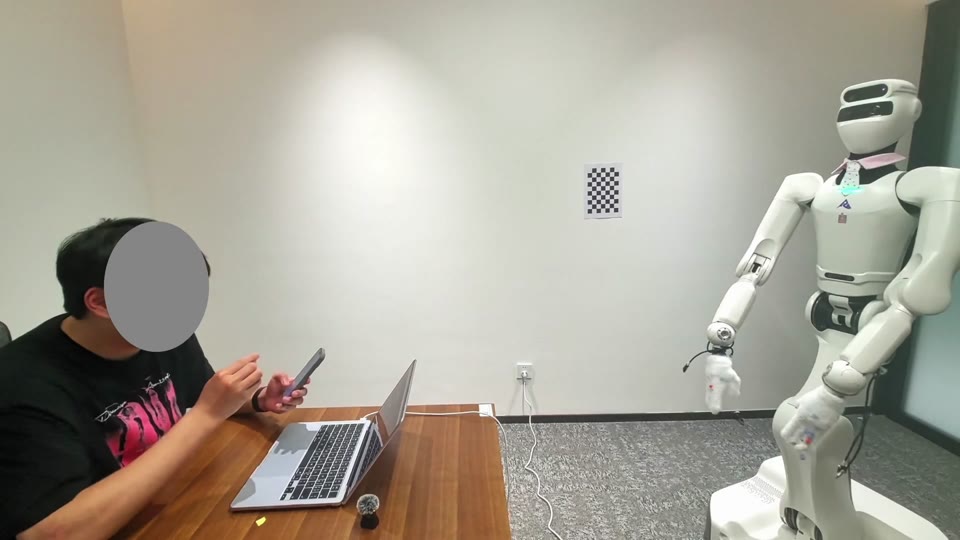
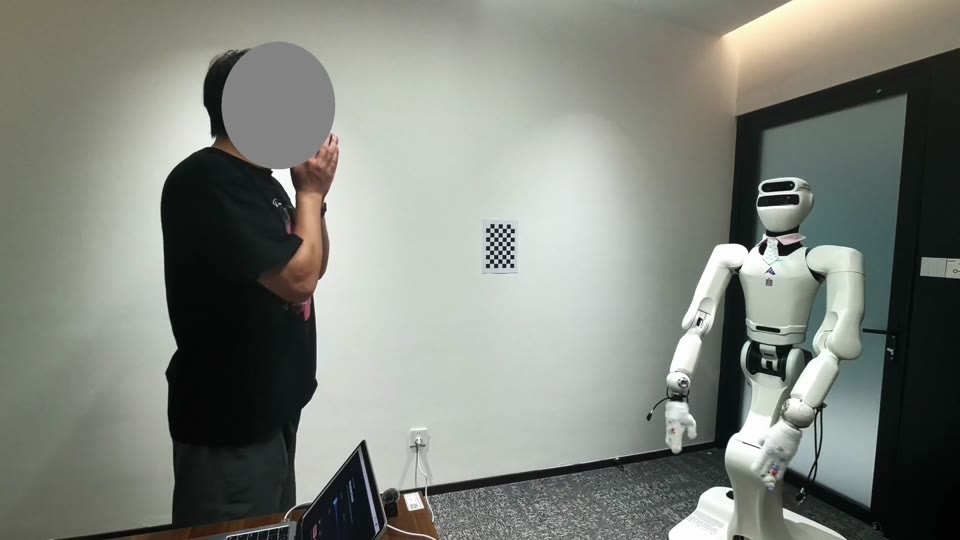
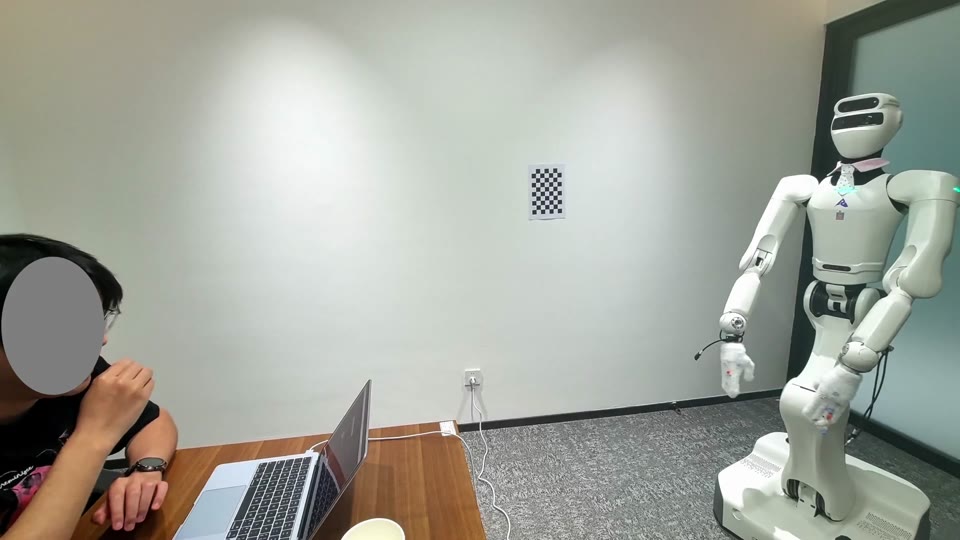
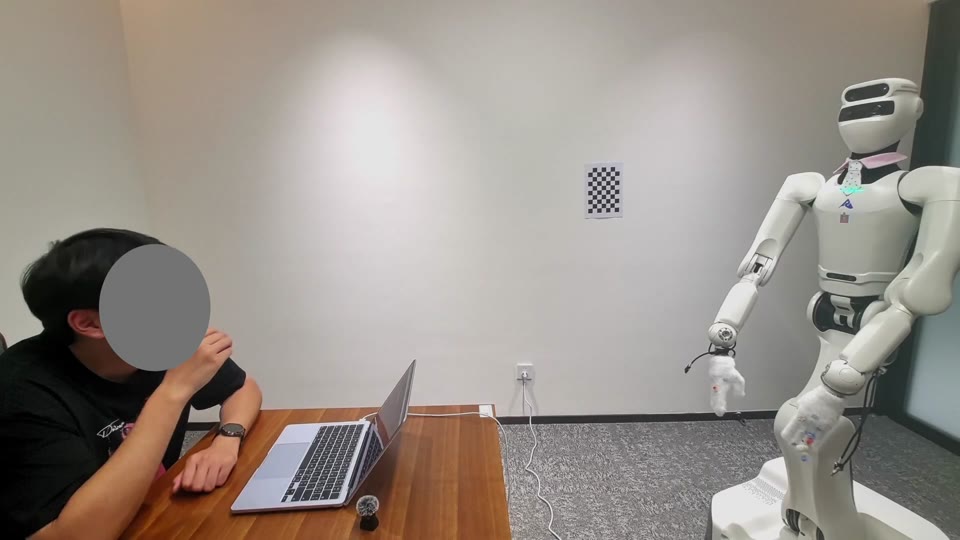
Embodied Interaction Policy
A Unified Model for Full-Duplex Human–Robot Interaction

Embodied Interaction Policy: A Unified Model for Full-Duplex Human–Robot Interaction
Demonstrations
Real-world interaction
Simulation
Abstract
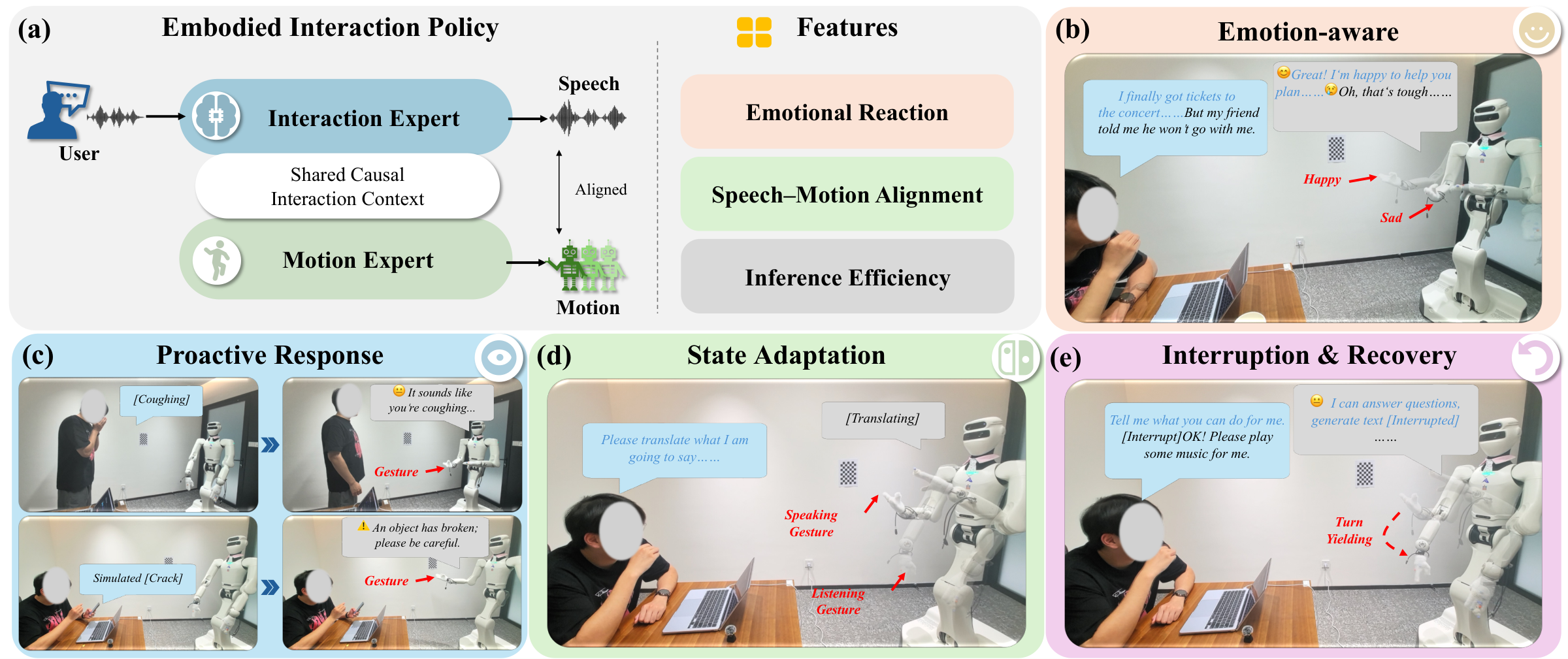
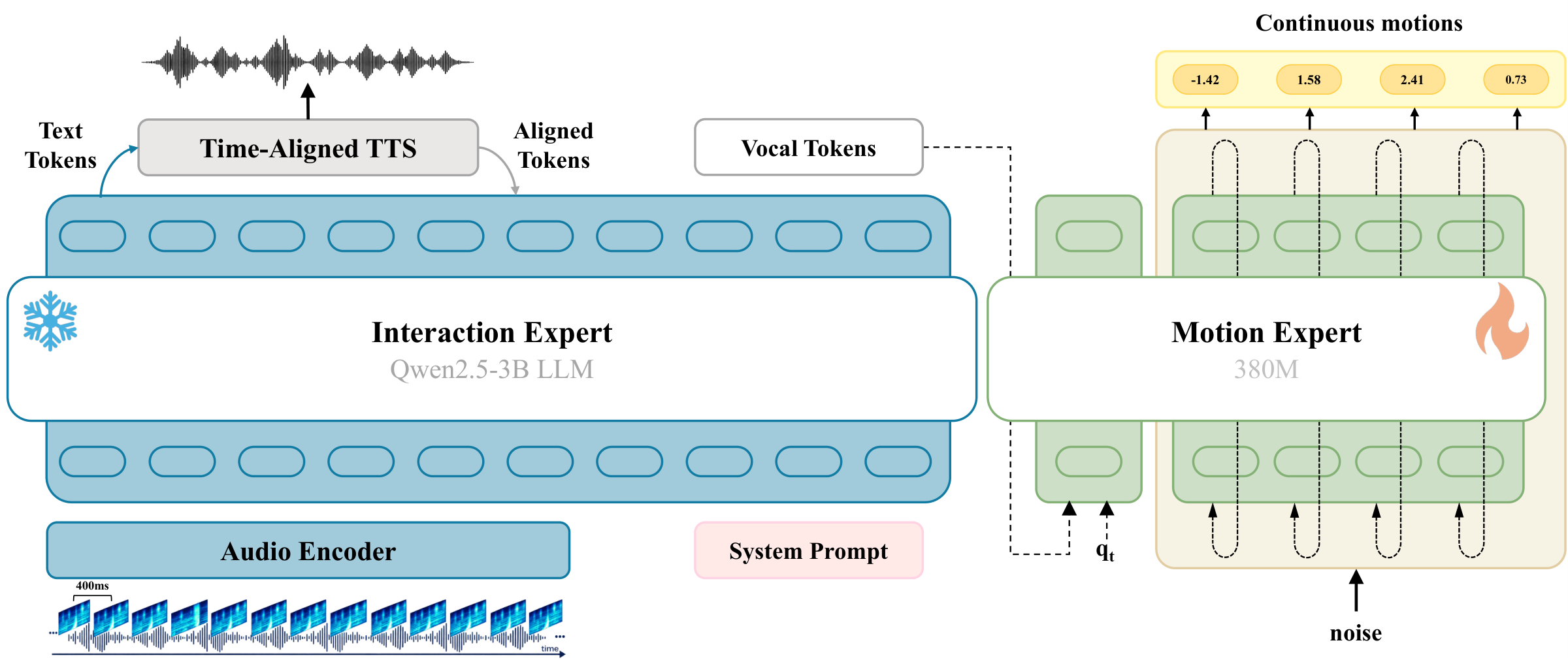
Real-time human-robot social interaction requires continuous coordination between speech and physical behavior. Existing systems often separate interaction agents from motion generation, complicating coordination as conversational states change. We propose Embodied Interaction Policy (EIP), a unified streaming framework that couples an Audio-Interaction expert with a motion expert through layer-wise joint attention. This allows motion generation to directly access the evolving interaction context.
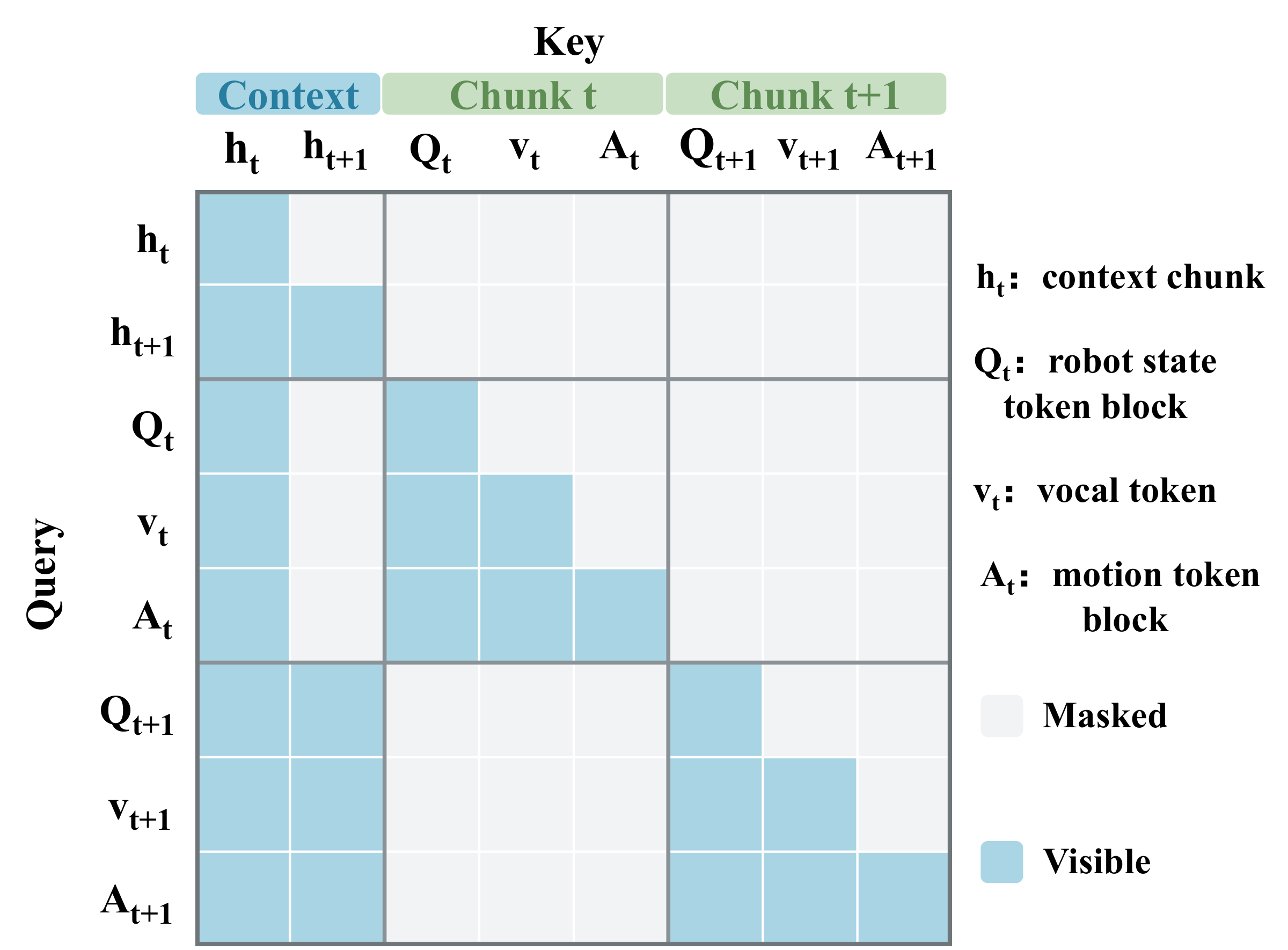
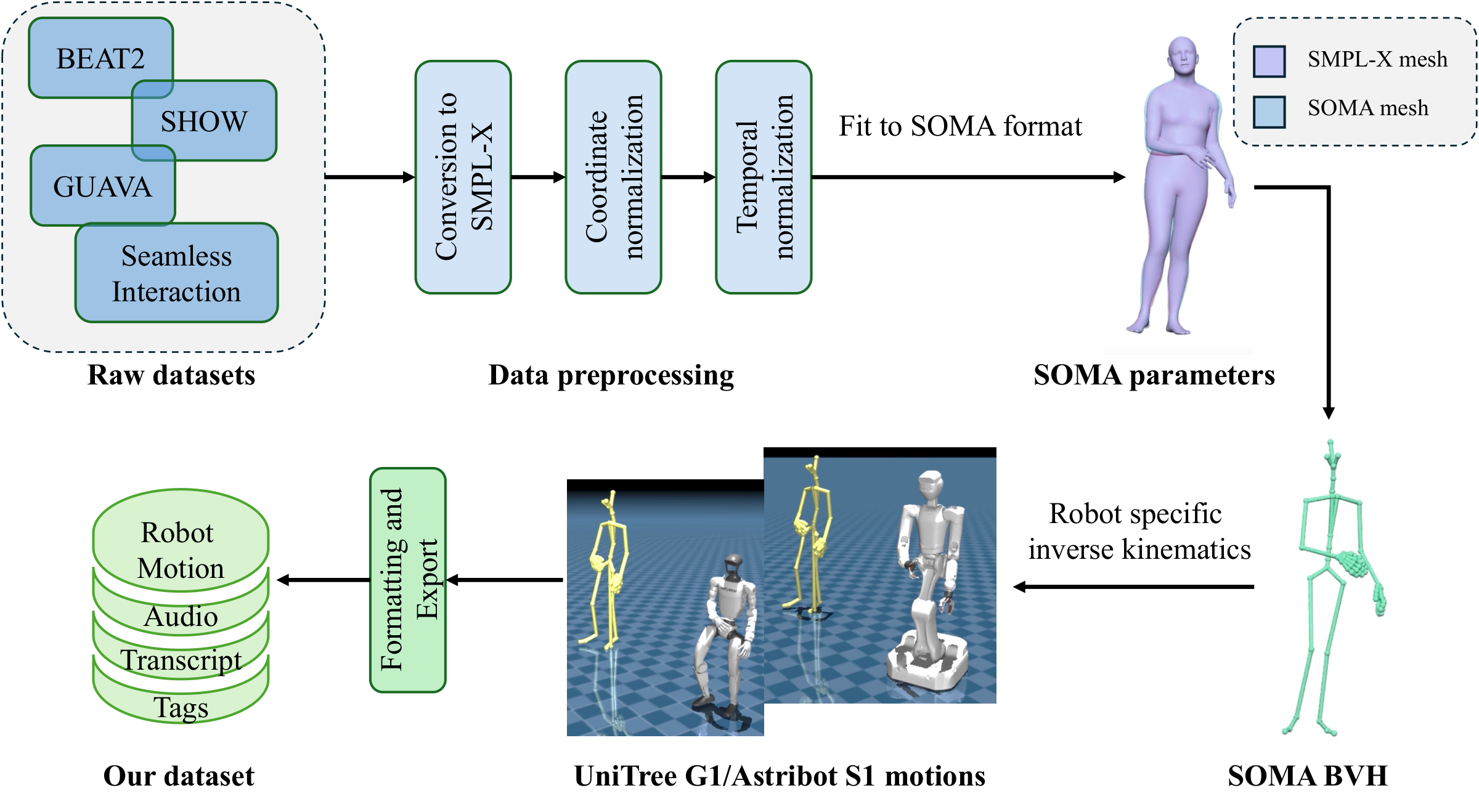
A chunk-wise causal mask prevents access to future context, while a vocal token encodes speaking state and the semantic emotion of the response. We construct Embodied Interaction Dataset (EI-Data) from co-speech and dyadic interaction data and train our model in two stages to learn state-adaptive and emotion-conditioned behavior. Combined with the frozen interaction expert, EIP supports continuous robot motion during proactive responses and interruption-aware turn-taking.
Quantitative evaluations demonstrate improved motion quality over representative gesture-generation baselines. Compared with a representative cascaded system, EIP achieves higher interaction success and reduces warm-start latency by 64%. Physical deployment and user studies further demonstrate improved motion naturalness and interaction comfort.
BibTeX
If you find this work useful, please consider citing our paper.
@misc{gui2026embodiedinteractionpolicyunified,
  title={Embodied Interaction Policy: A Unified Model for Full-Duplex Human-Robot Interaction},
  author={Youqiang Gui and Yunfei Liu and Lijian Lin and Ye Zhu and Jianan Wang and Cheng Peng and Yu Li},
  year={2026},
  eprint={2611.27327},
  archivePrefix={arXiv},
  primaryClass={cs.RO},
  url={https://arxiv.org/abs/2611.27327},
}